THE CARIBBEAN

A vast volcanic mountain chain lies along the floor of the Caribbean Sea. The tops of some of the mountains extend beyond the water to form many of the islands of the region. Other islands are cays (pronounced keez), low-lying coral islands, formed over thousands of years from the accumulation the skeletal remains of tiny sea animals.
The islands of the region are divided into three main groups—the Bahamas, the Greater Antilles, and the Lesser Antilles. The Bahamas is an archipelago, or a group of 700 islands north of the Caribbean Sea. People inhabit only about thirty of the Bahamian islands. South of the Bahamas are the largest islands of the Caribbean, called the Greater Antilles. The Greater Antilles include Cuba, Jamaica, Puerto Rico, and Hispañola. The largest islands of the Greater Antilles have rugged mountains and lush, thick rain forests. Hispañola is home to two nations: Haiti and the Dominican Republic. Most of the rest of the Caribbean islands form an arc that stretches from Puerto Rico to the coast of South America. These islands are known as the Lesser Antilles.

Dominican Republic:


Imagine a tropical paradise: palm trees swaying in the wind, beautiful white sand and clear sea. There's even fresh fruit at your fingertips. Now keep this image in mind while we learn about the Dominican Republic, or the DR.
The Dominican Republic and Haiti share an island, named Hispaniola, several hundred miles off the Florida coast in the Caribbean Sea.
 |
Because it's near the equator, the Dominican Republic has tropical, warm climates all year. It has just two seasons: a rainy season and a dry. Most homes in the DR don't have air conditioning; instead, residents leave their windows open so a breeze can pass through. This can be inviting to the island's geckos, mosquitoes, and even tarantulas!
Inland on the island, there are mountains and jungles. There are palm trees everywhere, and the beach is only a couple hours drive from any point on the island.
 |
Culture
The people of the Dominican Republic often sit outside and play dominoes and grab food at colmados (street stores). Their primary language is Spanish.
Baseball is popular in the DR. Many current and retired Major League Baseball players, including David Ortiz, Adrian Beltre and Sammy Sosa, were originally from the Dominican Republic.
Tropical fruit, including bananas and mangoes, can be found all over the island. People drink chinola (passion fruit juice) and coconut milk straight from coconuts, and they eat guayaba(guava). They also eat tostones (fried bananas) and empanadas(fried stuffed bread or pastries), and meals often are accompanied with rice and beans.
For cultural celebrations, people dress up in the colors of the flag: red, white, and blue. The boys often wear sombreros (cowboy hats) and red sashes around their waists. There is a large Carnaval, a carnival in which people walk around on stilts and hit people with balloons if they don't have on costumes!
Popular styles of music in the Dominican Republic include bachata and merengue, and there are two unique art styles. One has bright colors and tropical scenes, while the other has native symbols from the Taino people, the native people to the island.
MERENGUE MUSIC
The Merengue is the national dance of the Dominican Republic, and also to some extent, of Haiti, the neighbor sharing the island.
There are two popular versions of the of the origin of the Dominican national dance, the Merengue. One story alleges the dance originated with slaves who were chained together and, of necessity, were forced to drag one leg as they cut sugar to the beat of drums.
The second story alleges that a great hero was wounded in the leg during one of the many revolutions in the Dominican Republic. A party of villagers welcomed him home with a victory celebration and, out of sympathy, everyone dancing felt obliged to limp and drag one foot.
Merengue has existed since the early years of the Dominican Republic (in Haiti, a similar dance is called the Meringue or Mereng). It is possible the dance took its name from the confection made of sugar and egg whites because of the light and frothy character of the dance or because of its short, precise rhythms.
There is a lot of variety in Merengue music. Tempos vary a great deal and the Dominicans enjoy a sharp quickening in pace towards the latter part of the dance. The most favored routine at the clubs and restaurants that run a dance floor is a slow Bolero, breaking into a Merengue, which becomes akin to a bright, fast Jive in its closing stages. The ballroom Merengue is slower and has a modified hip action.
The Merengue was introduced in the United States in the New York area. However, it did not become well known until several years later.
SUAVEMENTE
Suavemente, bésame
Que quiero sentir tus labios
Besándome otra vez
Que quiero sentir tus labios
Besándome otra vez
Suavemente, bésame
Que quiero sentir tus labios
Besándome otra vez
Que quiero sentir tus labios
Besándome otra vez
bésame, bésame
(Suave) bésame otra vez
(Suave) que yo quiero sentir tus labios
(Suave) besándome otra vez
(Suave) besa, besa
(Suave) bésame un poquito
(Suave) besa, besa, besa
(Suave) bésame otro ratito
PUERTO RICO


(Suave) bésame otra vez
(Suave) que yo quiero sentir tus labios
(Suave) besándome otra vez
(Suave) besa, besa
(Suave) bésame un poquito
(Suave) besa, besa, besa
(Suave) bésame otro ratito
PUERTO RICO

MARC ANTHONY

Musician Marc Anthony was born Marco Antonio Muniz on September 16, 1968 in New York City. His parents, Guillermina and Felipe Muniz, are Puerto Rican and named their son after Marco Antonio Muniz, a Mexican singer who was popular in Puerto Rico.
Marc Anthony grew up in New York City with his sister, Yolanda Muniz. His talent was evident early on; Anthony realized that he had the singing voice, but needed to develop a stage presence to support it. This he did by singing backup as a session vocalist for freestyle and underground New York house music acts.
Marc changed his name, to avoid confusion with his namesake, and quickly became an in-demand backup singer; lending his voice to acts such as Menudo and the Latin Rascals.
His first release was a record called "Rebel," which debuted in 1988 from Bluedog Records, based in the Bronx. Marc Anthony continued perform in the New York club scene and also wrote songs, often teaming with Little Louie Vega and Todd Terry.
In 1992, Vega and Anthony played New York City's Madison Square Garden as an opening act for Tito Puente.
Soon after, Anthony changed his singing style from Freestyle and House to salsa and other Spanish music. Taking his inspiration from greats such as Puente, Ruben Blades, and Juan Gabriel, Marc Anthony released his first Spanish-language album in 1993. Titled Otra Nota, it included the salsa hit "Hasta que te conoci" (Until I Met You).
Commercial Success
He has never looked back; his albums and singles have been best-selling, with the exception of his two English-language albums, 1999s Marc Anthony and 2002s Mended. In his effort to crossover, it appears that Anthony may have turned away some of his core audience.
In 1998, Anthony appeared with Ruben Blades in Paul Simon's stage musical, The Capeman, which ran for 68 performances. Marc Anthony has also turned his prodigious talents to the big screen, appearing in movies such as 1996s Big Night and Man on Fire, released in 2004.
TITO PUENTE

Early Life
Famed jazz composer and bandleader Tito Puente was born Ernesto Antonio Puente Jr. in New York City on April 20, 1923. The son of Puerto Rican immigrants, Puente grew up in New York City's Spanish Harlem and became a professional musician at age 13. He learned to play a number of instruments as a child, beginning with the piano and then moving to percussion, saxophone, vibraphone and timbales (paired high-pitched drums).
Latin Music Sensation
Returning to New York in 1945, Puente used money from the G.I. Bill to study at New York City's famed Juilliard School. In 1948, he formed a band that would later become known as the Tito Puente Orchestra. By the 1950s, the band was attracting large crowds and Puente, subsequently, became known as a Latin music sensation.
In 1958, Puente released his best-selling album, Dance Mania, and more hit records soon followed, with notable songs including "Babarabatiri," "Ran Kan Kan" and "Oye Como Va." Fans enjoyed the way Puente put a big band spin on traditional Latin dances, mixing Latin sounds with jazz and other genres. Puente later added other Latin and Afro-Cuban rhythms to his repertoire, including cha-cha, merengue, bossa nova and salsa, and his continuous experimentation and creativity earned him a reputation as a musical pioneer.
Throughout his career, which spanned more than five decades, Puente performed with a number of leading jazz performers as well as with many symphony orchestras.
Puente received numerous awards for his work, including five Grammy Awards, the first of which he won in 1979.
In 1999, Puente was awarded an honorary degree at Columbia University.
Other Projects
In addition to music, Puente remained dedicated to causes affecting the Latin community throughout his lifetime. In 1979, he created a scholarship fund for Latin percussionists at the Juilliard School. "The scholarship was a dream of mine for a long time," Puente later said, explaining, "In the Latin community, we have a lot of gifted youngsters who don't get an opportunity to develop their talent because of a lack of money. Long after, I'm gone, the fund will be helping kids."
The jazz musician also guest-starred on several television shows, including The Simpsons.
Death and Legacy
By the end of his decades-long career, Tito Puente, sometimes called the "King of Latin Jazz" or simply "El Rey" ("The King"), had made an indelible mark on the popular culture. In addition to making more than 100 albums and creating more than 200 compositions, Puente had become a highly revered musician, regarded as a musical legend in Latin music and jazz circles.
Tito Puente died on May 31, 2000, at the age of 77, in a New York City hospital where he was awaiting heart surgery. Adored by fans across the globe, several supporters waited in line for days to say goodbye to the popular bandleader.

CUBA
Cuba is the largest island in the Caribbean Sea. Cuba and its neighbors form the Greater Antilles, a chain of islands created millions of years ago when two of Earth's tectonic plates collided.
Cuba is a long and narrow island. It stretches 750 miles (1,200 kilometers) from east to west, but is only 60 miles (100 kilometers) wide in most places.
High mountains and rolling hills cover about one-third of Cuba. The other two-thirds of the island are lowland plains used mainly for farming.
PEOPLE & CULTURE
The mixture of native, African, and European influences in Cuba gives this island a lively culture that is known around the world. The introduction of communism to the country in 1959 has had a big impact on the people, both positive and negative.
Cuba's history is reflected in its food, language, art, and, most of all, its music. All year round, it seems as if bands are everywhere in Havana. The main musical form is called son, which combines lively rhythms with classical guitar.
Unlike most countries in Latin America, Cuba's favorite sport is not soccer. It's baseball! Baseball came to Cuba from the United States in the 1860s. Many international baseball stars have come from Cuba, and the Cuban national team is one of the best in the world.
RUMBA
Contrary to what many people think, Cuban rumba did not originate in slave plantations, but rather in solares—the areas where freed slaves lived after slavery was abolished in 1886. It began as a marginalized type of get-together—rumba is also a synonym of “party”—where people of African descent would play music and chant while dancing very rhythmic dances.
For a long time and until the social changes brought about by the government that took power in 1959, rumba was perceived negatively as a vulgar cultural expression of poor and uneducated people. Rumba, now recognized as a valuable part of Cubans’ intangible heritage, is taught in dance academies and dance companies such as Conjunto Folklorico Nacional de Cuba, and Danza Contemporanea includes rumba numbers in their presentations.
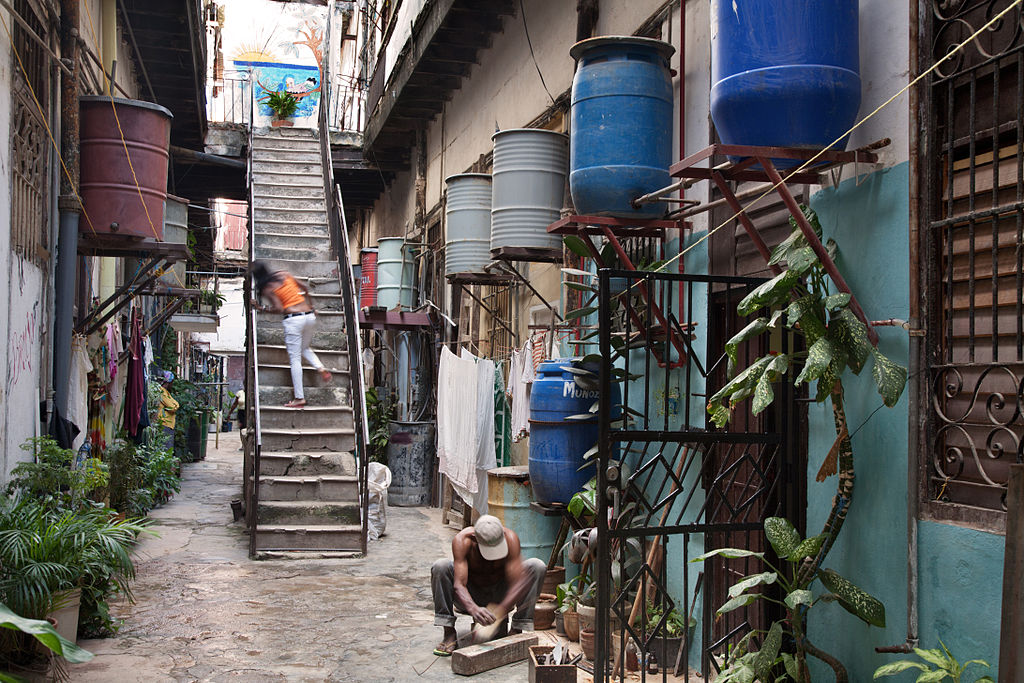
Rumba originated in poor communal buildings (solares) outside cities and near the docks | © Jorge Royan / http://www.royan.com.ar / WikiCommons
What exactly is rumba?
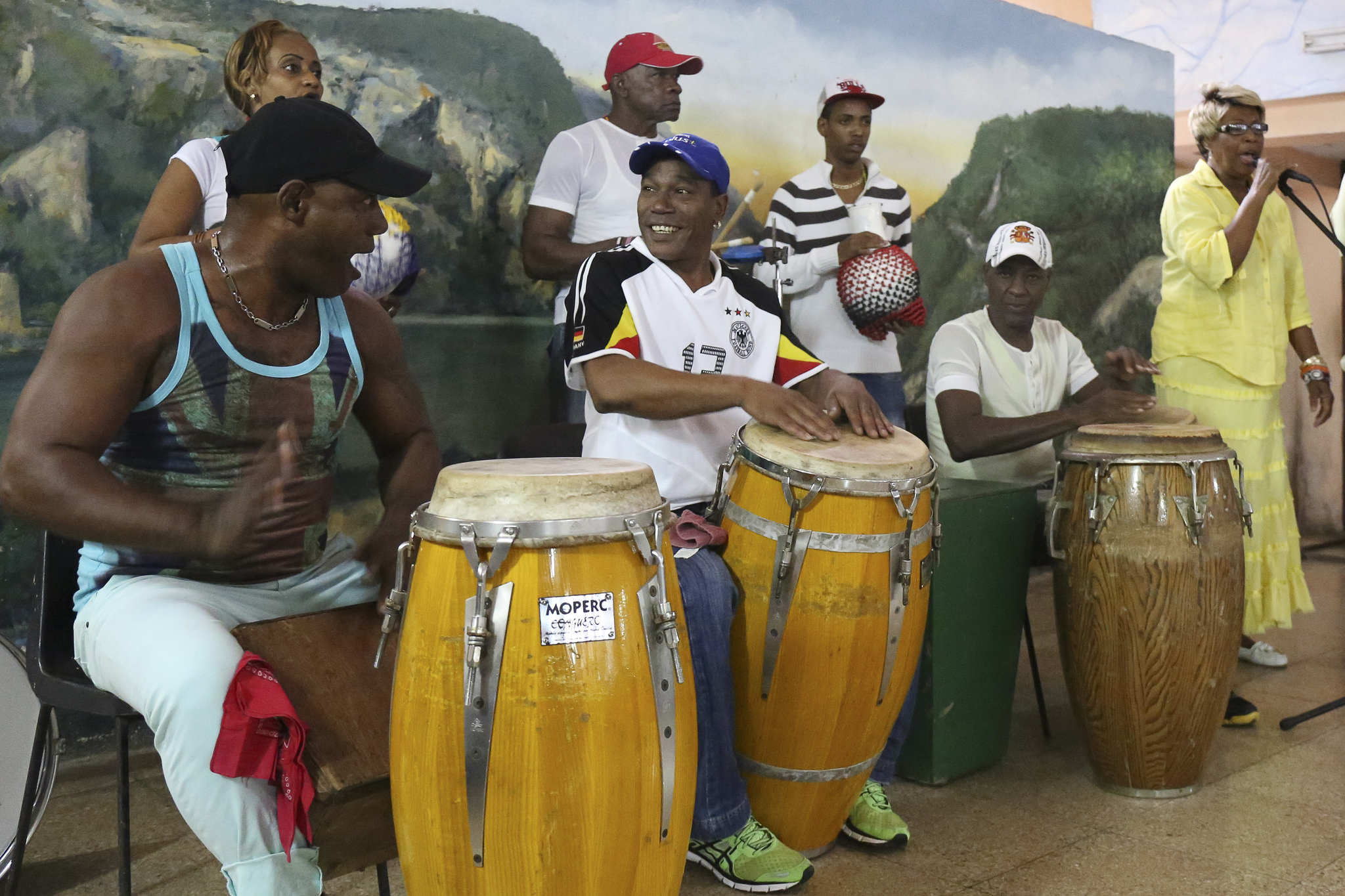
Rumba may refer to either the music (both percussion and singing) or the dance, which, when combined, are the center of a traditional African-Cuban performance.
Musicians perform the music with three drums that have different names (quinto, salidor, tres golpes) and differ in size and sound. Wooden boxes are also used sometimes, depending on what’s available. Other instruments include claves, which can also be replaced by spoons, and some bands use marugas or chekeres.
A very good way to understand rumba is to have a look at its most original form: the solar rumba (as opposed to more artistic forms designed for theaters, ballrooms, and international tours). The central patios of poor communal buildings where freed slaves and their descendants lived after abolition were the natural scenarios for rumba. Someone would start drumming on a wooden box, someone else would join in by striking a pair of sticks (or spoons), and more and more people would show up to take part in the party.
Younger people would dance to faster rhythms, in ways that were either more powerful and acrobatic or more sensual, while older folks would get their chance to dance too but to slower beats, more in agreement with their age.
Te la pasa
pediente a la gente
cuidao se te cema
Ponte pa lo tuyo
hasta tu tiene problema
Te la pasa
pediente a la gente
cuidao se te cema
Ponte pa lo tuyo
hasta tu tiene problema
NEW ORLEANS

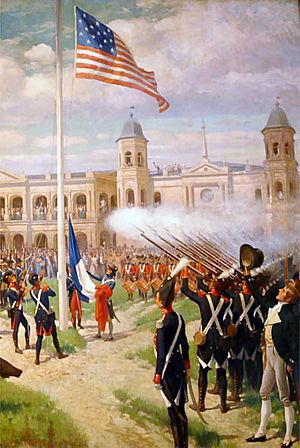
Hoisting of American Colors over Louisiana. Painting depicting first raising of the USA flag with the Louisiana Purchase, in main plaza (now Jackson Square), New Orleans. Ceremony was December 20, 1803. Painting by Thure de Thulstrup on commission to commemorate centennial of the event. The painting has been praised for the research and historical accuracy which went into the period depiction. Painting is on display in the Cabildo Museum.
The history of New Orleans, Louisiana, traces the city's development from its founding by the French, through its period under Spanish control, then briefly back to French rule before being acquired by the United States in the Louisiana Purchase. In the 19th century, it was the largest port in the South, exporting most of the nation's cotton output and other products to Western Europe and New England. It was the largest and most important city in the South; thus it was an early target for capture by the Union during the Civil War. With its rich and unique cultural and architectural heritage, it remains a major destination for tourism, conventions, and major sports events, even after the major destruction and loss of life during Hurricane Katrina and flooding from the levee break after the hurricane in 2005.
Always, forever, the city’s music is its beating heart – especially true during Mardi Gras, Jazz Fest and other celebrations. The musical notes of jazz, brass, R&B, soul and many mixes fill the air along with night–blooming jasmine and other fabulous tropical fragrances. Walk down Frenchmen Street, the main artery of the Marigny neighborhood adjacent to the French Quarter and take in the vibrant blocks of cafes, music clubs and restaurants including Snug Harbor, d.b.a. and the Spotted Cat. New Orleans has produced its share of musical giants, from greats like Louis Armstrong, Dr. John and Allen Toussaint to contemporary acts like Trombone Shorty, Big Freedia and Hurray for the Riffraff. Preservation Hall on Bourbon Street is always a hit but also visit the Mother-In-Law Lounge on Claiborne Avenue, Rock-N-Bowl in Mid-City, the Maple Leaf Uptown and Vaughn’s in the Bywater. These local dives and music venues will keep you dancing all night. It’s all part of the magic, part of the brilliant je ne sais quoi that is found only in New Orleans.
"Iko Iko" (/ˈaɪkoʊ
My grandma and your grand-ma were sit-tin' by the fire
My grandma told your grand-ma "I'm gon-na set your flag on fire
My grandma told your grand-ma "I'm gon-na set your flag on fire
Talk-in' 'bout, hey now hey now I-ko, I-ko, un-day
Jock-a-mo fee-no ai na-né, jock-a-mo fee na-né
Jock-a-mo fee-no ai na-né, jock-a-mo fee na-né
Look at my king all dressed in red I-ko, I-ko, un-day
I bet-cha five dol-lars he'll kill you dead, jock-a-mo fee na-né
I bet-cha five dol-lars he'll kill you dead, jock-a-mo fee na-né
Talk-in' 'bout, hey now hey now I-ko, I-ko, un-day
Jock-a-mo fee-no ai na-né, jock-a-mo fee na-né
Jock-a-mo fee-no ai na-né, jock-a-mo fee na-né
My flag boy and your flag boy were sit-tin' by the fire
My flag boy told your flag boy "I'm gon-na set your flag on fire"
My flag boy told your flag boy "I'm gon-na set your flag on fire"
Talk-in' 'bout, hey now hey now I-ko, I-ko, un-day
Jock-a-mo fee-no ai na-né, jock-a-mo fee na-né
Jock-a-mo fee-no ai na-né, jock-a-mo fee na-né
See that guy all dressed in green I-ko, I-ko, un-day
He's not a man, he's a lov-in' ma-chine jock-a mo fee na-né
He's not a man, he's a lov-in' ma-chine jock-a mo fee na-né
Talk-in' 'bout, hey now hey now I-ko, I-ko, un-day
Jock-a-mo fee-no ai na-né, jock-a-mo fee na-né
Jock-a-mo fee-no ai na-né, jock-a-mo fee na-né
Talk-in' 'bout, hey now hey now I-ko, I-ko, un-day
Jock-a-mo fee-no ai na-né, jock-a-mo fee na-né
Jock-a-mo fee-no ai na-né, jock-a-mo fee na-né
Jock-a-mo fee-no ai na-né, jock-a-mo fee na-né

No comments:
Post a Comment